
WHAT THIS STUDY IS
A landmark review from Boston University School of Medicine examining the relationship between testosterone deficiency, metabolic syndrome, and erectile dysfunction. With over 400 citations in the scientific literature, it remains one of the most referenced papers in men's hormonal health — cited by researchers, urologists, and endocrinologists worldwide as the foundational framework for understanding why testosterone deficiency matters far beyond libido.
THE CORE FINDING
Low testosterone, metabolic syndrome, and erectile dysfunction are not three separate problems. They are a connected biological cluster — each one driving the others. The authors argue that testosterone deficiency may be the common denominator running through all of them.
THE CHAIN
The paper maps a specific biological pathway:
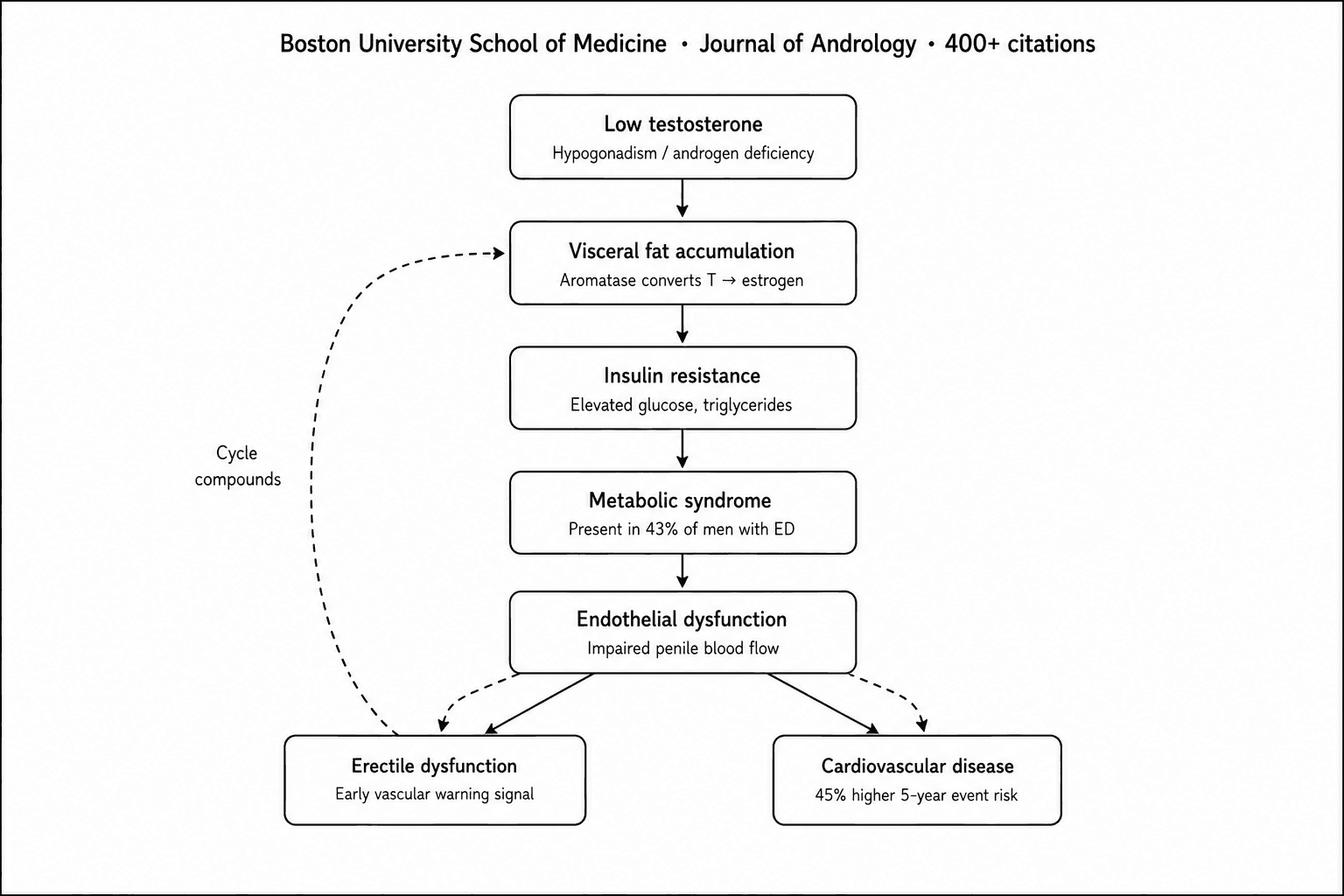
Low testosterone → increased visceral fat accumulation → insulin resistance → metabolic syndrome → endothelial dysfunction → erectile dysfunction → cardiovascular disease
Each step is documented across multiple independent studies. This isn't a hypothesis — it's a well-evidenced mechanistic chain that explains why men with low testosterone tend to gain abdominal fat, why that fat further suppresses testosterone, and why ED in a younger man is often the first visible signal of a deeper metabolic problem.
KEY DATA POINTS
In a study of 154 men with erectile dysfunction, 43% had metabolic syndrome — nearly double the general population rate of 24%
79% showed insulin resistance — three times the general population rate
As ED severity increased, metabolic syndrome prevalence rose from 14.5% in mild cases to 50% in severe cases
Men with higher testosterone consistently showed fewer metabolic syndrome components across multiple large independent studies
Testosterone therapy in genuinely hypogonadal men was associated with reduced body fat, increased lean mass, improved lipid profiles, and lower fasting glucose
THE OBESITY CYCLE
One of the paper's most important contributions is explaining the self-reinforcing cycle that traps many men:
Visceral fat increases aromatase activity, which converts testosterone to estrogen. That estrogen suppresses the body's own testosterone production via negative feedback. Lower testosterone then reduces metabolic rate and lipolysis, depositing more visceral fat. The cycle compounds over time — which is why lifestyle changes alone often prove insufficient once it's established.
WHY THIS MATTERS
For too long, low testosterone has been framed as a problem of aging men with low libido. This paper reframes it as a metabolic and vascular health issue affecting men across age groups. Erectile dysfunction — often dismissed as psychological in younger men — is documented here as a measurable cardiovascular warning signal, with men presenting with ED showing a 45% higher risk of a cardiovascular event over a five-year follow-up period.
The clinical implication is straightforward: addressing testosterone deficiency early is not a lifestyle upgrade. It is a health intervention with documented downstream effects on body composition, metabolic function, and vascular health.
Read the full journal here: https://onlinelibrary.wiley.com/doi/10.2164/jandrol.108.005215