
WHAT THIS STUDY IS
A prospective, 8-year observational registry study from Boston University School of Medicine comparing 360 hypogonadal men treated with testosterone therapy against 296 hypogonadal men who remained untreated. With a median follow-up of 7 years, it is one of the longest real-world TRT outcome studies in the published literature.
THE HEADLINE FINDING
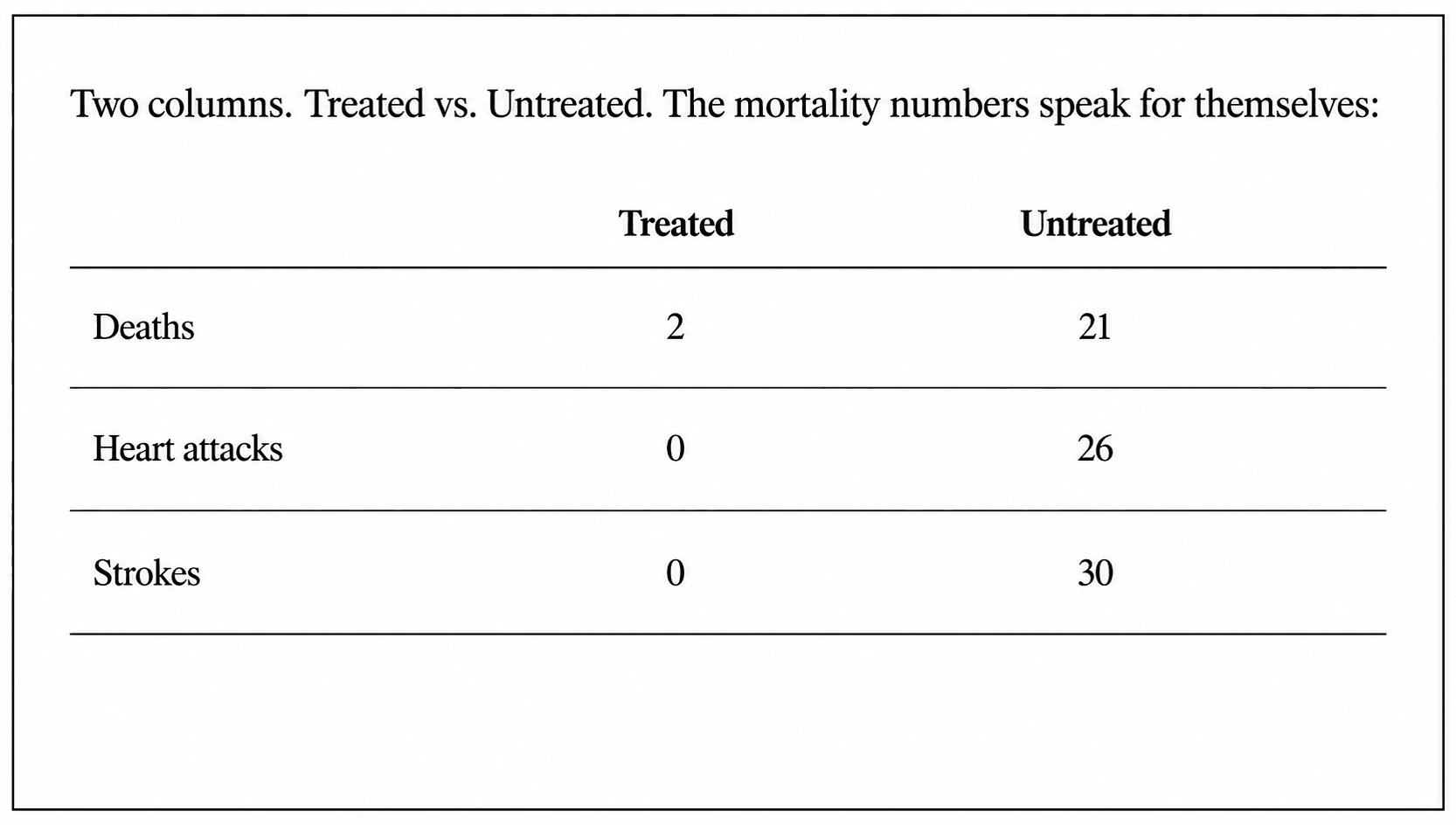
In the untreated group: 21 deaths, 19 from cardiovascular events. 26 non-fatal heart attacks. 30 non-fatal strokes.
In the testosterone-treated group: 2 deaths, neither from cardiovascular causes. Zero heart attacks. Zero strokes.
The estimated reduction in cardiovascular mortality for the treated group was between 66% and 92%.
KEY DATA POINTS
Body composition
Treated men lost an average of 19 kg over 8 years
Waist circumference decreased by 10 cm in the treated group and continued to increase in the untreated group
BMI dropped from 33.1 to 28.0 in the treated group — from obese to overweight range
Metabolic markers
Fasting blood glucose decreased significantly in the treated group; remained unchanged in controls
HbA1c dropped from 6.9% to 5.6% in treated men — while it increased from 6.1% to 6.4% in untreated men
Total cholesterol fell from 7.2 to 4.8 mmol/L in the treated group; rose in controls
LDL decreased, HDL increased, triglycerides decreased — all significantly
Blood pressure
Systolic blood pressure decreased from 151 to 130 mmHg in treated men
Diastolic blood pressure decreased from 90.6 to 74.4 mmHg
Both measures increased slightly in the untreated control group
Prostate safety
Prostate cancer was diagnosed in 1.9% of treated men vs 4.1% of untreated men
WHAT MAKES THIS STUDY SIGNIFICANT
Most TRT studies run 6–12 months. This registry tracked real patients for up to 8 years in a clinical setting. The control group — men who chose not to treat primarily due to cost or negative perception of TRT — provides a direct, real-world comparison that short-term placebo-controlled trials cannot replicate.
The authors also directly address the studies that purported increased cardiovascular risk from TRT, noting that the FDA itself reviewed those studies and concluded they were neither credible nor convincing due to methodological flaws. Seven subsequent independent studies confirmed no increased CV risk from TRT.
THE BOTTOM LINE
Untreated testosterone deficiency is not a neutral condition. Over an 8-year period, untreated hypogonadal men in this registry experienced dramatically higher rates of cardiovascular death, heart attack, and stroke — while men on continuous TRT showed sustained improvements across every measured metabolic and cardiovascular parameter. This is the closest thing available to long-term real-world outcomes data for TRT.
Read the full journal here: https://pmc.ncbi.nlm.nih.gov/articles/PMC5555449/